 Free quote
Gwinnett County
Brass landscape lighting in Buford, GA — Lake Lanier slopes, wooded lots, steps and paths down to the dock, and lighting that reads from the water.
Buford is the most varied town on our service list and the one where landscape lighting does the most work. Within a few miles you have a historic mill-town core, new construction to the north and east, and the Lake Lanier shoreline — and the lake lots are where a ground-up lighting design stops being decoration and starts being how you get from the house to the water.
Bridges Lighting Pros installs solid brass low-voltage lighting across Buford and Hall County. Call (770) 630-4653.
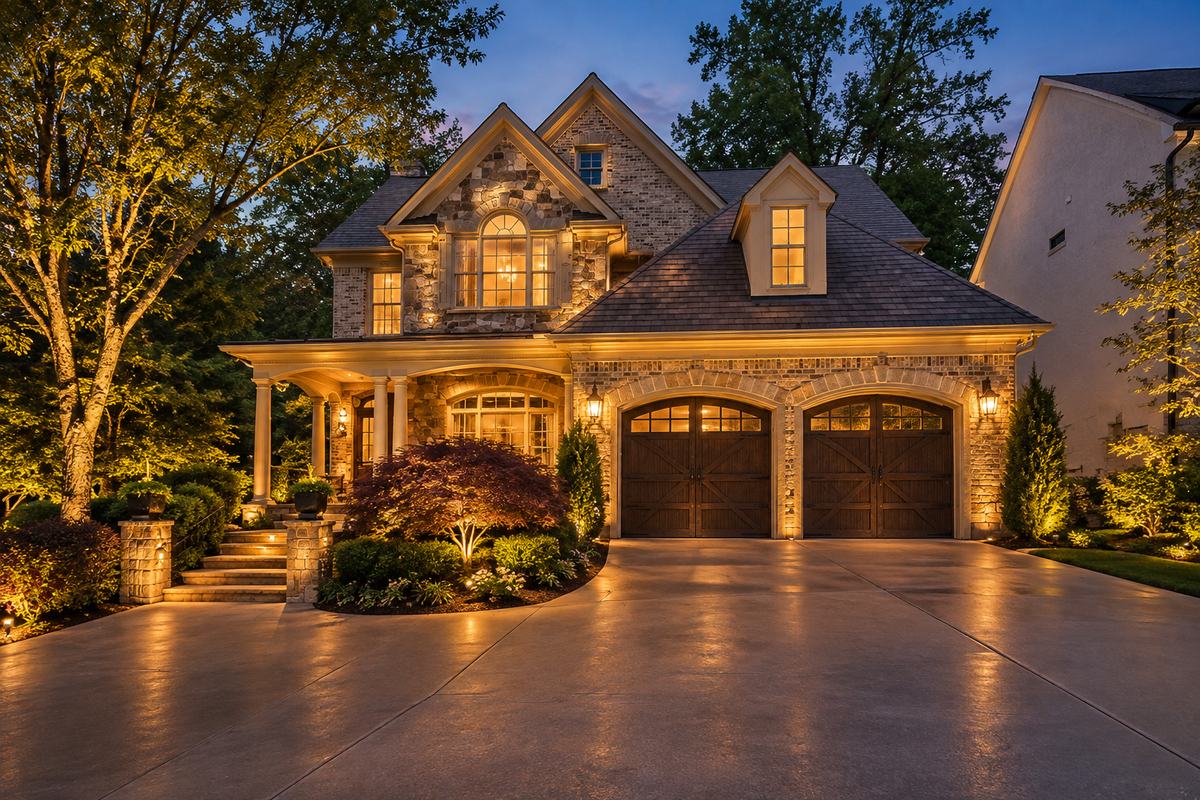
A typical Lanier property falls away from the house toward the water, often steeply, usually wooded, frequently with a mix of steps, landings, a path and a dock walkway between the back door and the boat.
That sequence is the design. Not the house — the route. Somebody carrying cushions and a cooler down a wet slope at nine at night needs to see the ground, and that is a lighting problem with a specific answer.
Step lights set into the risers rather than aimed across the treads. Low fixtures at each landing and at every change of direction. Nothing at eye level on the way down, because a fixture you look into on a descent destroys your night vision at exactly the wrong moment. The whole path can run dim — far dimmer than people expect — because the eye adapts as you go.
The same slope that makes the walk a problem makes the planting spectacular to light. On a steep lot you get to light trees from below and from the side, and you can see the result from above — from the deck, from the house, looking down through the canopy.
Downlighting comes into its own here. A shielded fixture mounted high in a tree and aimed down through the branches drops a pattern of light and shadow across the slope, and because there is no visible source it reads as moonlight. On flat ground moonlighting is a nice effect. On a wooded drop toward the lake it is the whole reason to do the job.
Cable runs on a slope want thought. Buried shallow across a grade, cable finds the same paths that stormwater does, and a washout will surface it. Routing along contours rather than straight down the fall line, and staying out of the obvious drainage channels, is the difference between a system that stays buried and one you are re-burying after every hard summer storm.
Dock lighting is genuinely different from lighting a garden, for one reason: it is viewed from the water as well as from the land.
Anything aimed outward becomes glare for a boat coming in. Dock fixtures should be low, shielded and aimed at the deck surface, marking the edges and the cleats rather than throwing light across the cove. Low-voltage lighting in dock post caps and along the walkway does everything that is needed.
Hardware near water also has to be chosen for it. This is the clearest case for solid brass on the whole service list. Constant humidity, splash, and a fixture sitting in that atmosphere three hundred and sixty-five days a year will pit aluminium and blister powder coat within a couple of seasons. Brass oxidises to a patina and then stops. The same is true of the connectors — a proper gel-filled waterproof connection at every joint rather than a twist cap, which is the single most common failure point on a lakeside system.
The mill-town core is a different job again. Older houses, smaller lots, mature street trees, and a lot of brick and painted wood that grazes well.
On a narrow lot the fixture count is low and placement is everything, because neighbouring windows are close. Aiming a flood up a wall is easy; aiming it so it does not put light into the house next door takes a shield, a tighter beam, or a different position. It is worth saying out loud that a good design here is partly about where light does not go.
The newer Buford and Hamilton Mill builds have young landscaping, which changes the advice honestly: there may not be much worth uplighting yet.
On a three-year-old lot, the money is usually better spent on the hardscape and the approach — wall washing on stone or block, step and path lighting, lighting the columns and the entry — with tree uplighting added in a later phase once the planting has size. We will say that rather than sell you fixtures pointed at shrubs that are still knee-high.
Size the transformer for the later phase now, though. Headroom costs almost nothing at install and saves a second transformer and a second outlet in five years.
Services
Nearby
Questions
Sometimes, and less often than on an inland house. The front elevation of a lake property is frequently the least-seen side, and the lake-facing elevation is usually glass, deck and stepped rooflines that do not take a clean channel run.
We do install it in Buford where a roofline suits it. On most lake lots the budget goes further on the slope, the path and the trees.
It affects everything that is not brass and not properly connected. Fixture bodies, lamp sockets, connectors and the transformer enclosure all have to be specified for a wet environment, and that is a spec question to ask any installer quoting a shoreline property.
Yes. Water reflects, so a fixture aimed anywhere near the surface doubles its apparent brightness and throws it back at the house and at passing boats. Light gets aimed at ground, bark and stone, not across open water.
Heavier gauge cable, a multi-tap transformer, and the run split into zones. On a drop of a few hundred feet, voltage arriving at the last fixture is the thing that decides whether the far end looks the same as the near end.
No. Low-voltage landscape lighting stays in year-round here. What it does need is an annual look — re-aiming, clearing leaf litter off lenses, and checking connections on anything near the shoreline.
Yes — Buford, Hamilton Mill, Sugar Hill, Suwanee, Flowery Branch and the southern Hall County shoreline.
Call (770) 630-4653 for a dusk walkthrough in Buford.
Get in touch
Call and talk to someone who does the work, or send the details and we'll get back to you.
Call (770) 630-4653