 Free quote
Fulton County
Brass landscape lighting on Milton, GA estate lots — long drives, equestrian properties, pasture fence lines and phased designs. Planned on site, after dark.
Milton is the acreage end of north Fulton, and acreage changes what outdoor lighting even means. On a half-acre subdivision lot the house is the property. On five or fifteen acres with a quarter-mile drive, pasture, outbuildings and a tree line, the house is one object among several — and most of what makes the place worth looking at after dark is in the ground, not on the roof.
Bridges Lighting Pros designs and installs solid brass low-voltage lighting across Milton. Call (770) 630-4653.
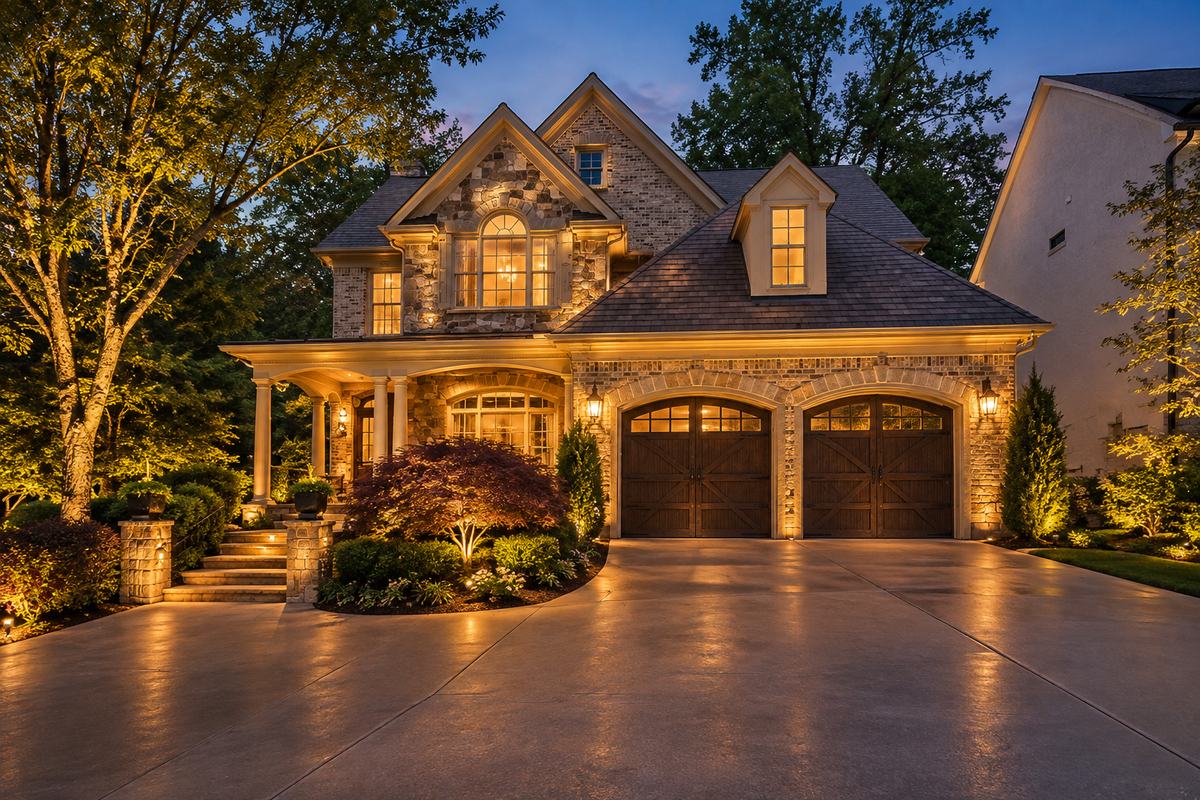
The single biggest lighting decision on a Milton estate lot is the drive, and it is usually made badly.
The instinct is to line both sides with path fixtures at a fixed interval. On a four-hundred-foot approach that produces an airstrip — twenty-eight identical pools of light and no sense of arrival whatsoever.
What works is lighting the structure of the approach rather than its length. The entry piers or gate. Each bend. The crest where the house first becomes visible. The point where the surface changes or the drive splits. Between those, the useful light comes from uplit trees standing back off the drive — a lit oak canopy fifty feet away throws enough ambient light to read the verge by, and it looks like an estate rather than a runway.
Fence lines are worth a word too. Milton's board fencing is a defining feature of the place, and a few low fixtures grazing along a run of painted board near the entry does more for the character of a property than another dozen path lights.
The technical reality of a big lot is distance, and distance is where landscape lighting quietly fails.
Low-voltage cable loses voltage over its length. A lamp fed twelve volts at the transformer can be receiving ten at the end of a three-hundred-foot run, which reads as dimmer and distinctly more orange than the fixtures near the house. It never looks like a fault. It looks like a design that does not quite work, and people live with it for a decade.
On Milton properties the answer is usually more than one transformer. Rather than pushing everything from a single unit at the house, we put a transformer near each cluster of load — the entry, the barn, the rear terrace — fed from whatever power already exists in that part of the property. Heavier gauge cable and multi-tap transformers handle what is left.
Where there is genuinely no power near a far fixture group, that is a line item to raise on the design visit, not a surprise on install day. It is the most common thing that moves a price on a large lot.
Barns, arenas, run-in sheds and detached garages are part of the job here, and they are usually cheaper to include than owners expect once cable is already in that half of the property.
The useful principle is that working areas and viewed areas want different light. A barn aisle or a wash stall needs functional light you switch on. The outside of the barn — the gable, the cupola, the doors — wants the same low-voltage treatment as the house, so that from the terrace the barn reads as part of the composition rather than a dark block.
Arena lighting is a different trade with different fixtures and we will say so rather than pretend a landscape system covers it.
Milton's design standards and its whole appeal rest on not looking like a subdivision, and lighting is one of the quickest ways to break that.
The rules that keep a property looking rural after dark are simple. Warm white at 2700K, nothing cooler. Shielded fixtures, so you see lit objects and never a source. Nothing aimed upward into open sky, and nothing spilling over a property line onto a neighbour's pasture. And considerably less total light than the lot could carry — on acreage, the dark between lit things is most of the effect.
A Milton property lit properly is noticeable for how little you can see of the equipment.
Services
Nearby
Questions
The sequence that works: the entry and the approach, then the house's principal elevation and the two or three best trees near it, then the outdoor living areas you actually use, then outbuildings, then the far tree line — which many properties never need at all.
Yes, and on a large lot it is usually the right way to buy it. The requirement is that phase one is designed with the whole property in mind — transformer locations, capacity headroom and cable routes planned for what is coming, even if it is three years out.
By putting a transformer near the load rather than running low voltage a quarter of a mile. Most Milton properties already have power at the barn, at a well house, or at the entry, and that is usually the answer.
Barns and outbuildings, yes, as part of the landscape system. Arena lighting is a separate specification and a different conversation.
On a long approach, often yes. It is the first thing anyone experiences and the part that most needs to be navigable. A beautifully lit house at the end of an invisible drive is a strange piece of design.
Sometimes, on the houses with a clean, visible front elevation. Less often than in town — a house set back three hundred feet behind trees shows very little roofline from anywhere anyone stands, and the same money spent on the drive and the specimen trees changes the property far more. We install it where it earns its place and say so where it does not.
Fixtures get moved and re-aimed. Planting grows, pastures get re-fenced, trees come down in storms. An annual service visit keeps a large system aimed at what is actually there rather than what was there when it went in.
2700K warm white throughout, and consistently. Cooler light turns bark grey and foliage blue, and on a rural property it reads as a commercial yard from half a mile away. Mixing temperatures across a lot is more visible than any single wrong choice, so everything from the entry piers to the barn runs the same.
Yes — Milton, Crabapple, Alpharetta, Roswell and the surrounding north Fulton area.
Call (770) 630-4653 for a dusk walkthrough in Milton.
Get in touch
Call and talk to someone who does the work, or send the details and we'll get back to you.
Call (770) 630-4653