 Free quote
Fulton County
Brass landscape lighting in Johns Creek, GA. Thirty-year canopy over large brick traditionals — grazing stone, moonlighting, and design-review HOAs.
Johns Creek is where the design work stops being optional. The city is built largely of substantial brick and stucco traditionals on generous lots, and those lots were planted thirty years ago. The trees have caught up with the houses, which is precisely the condition landscape lighting was invented for.
Bridges Lighting Pros installs solid brass low-voltage lighting across Johns Creek and north Fulton. Call (770) 630-4653.
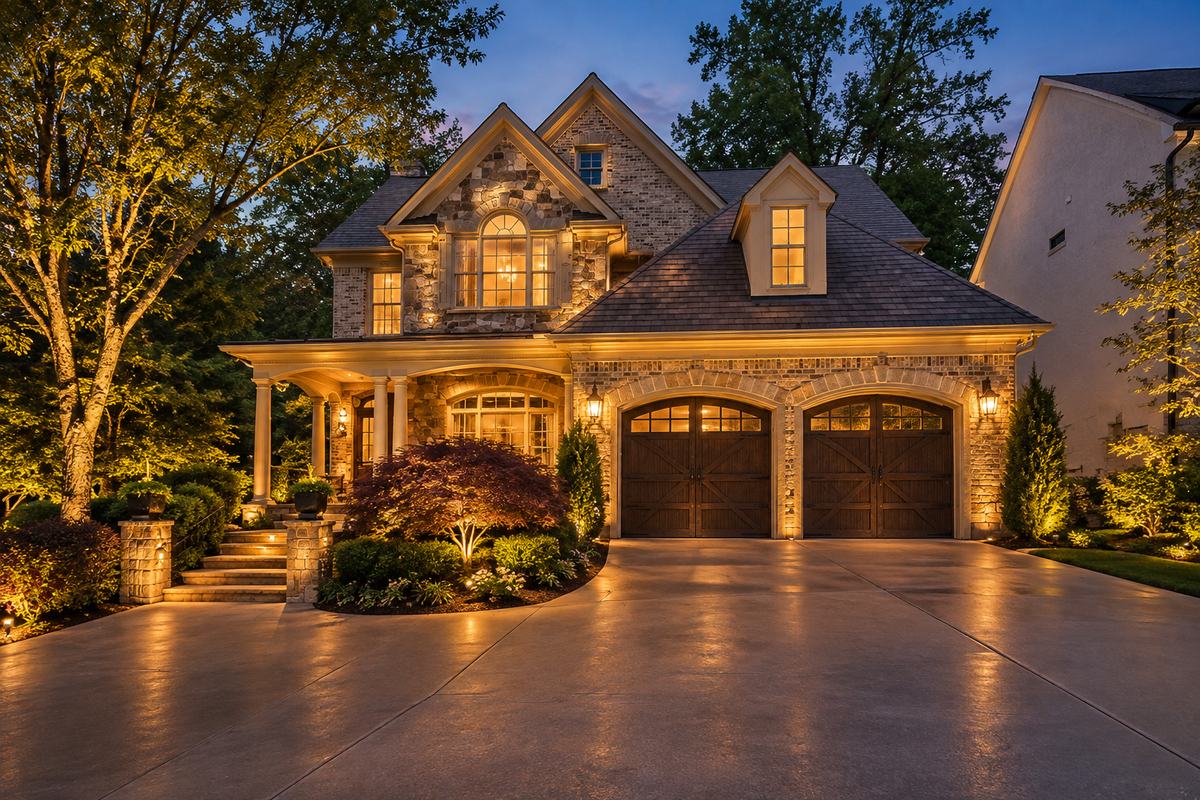
The oaks, maples and poplars on a mature Johns Creek lot are now big enough that they, not the house, set the scale of the property after dark.
Two techniques do most of the work. Uplighting a specimen from two positions several feet off the trunk, aimed to cross, fills the branching structure with light and gives it depth — one fixture dead at the base flattens a tree into a lit pole. And moonlighting, where a shielded fixture sits thirty or more feet up in the canopy aimed down, drops branch shadows across the lawn and the drive with no visible source at all.
Moonlighting is the single most under-requested technique in the trade and the one that suits this city best, because it needs exactly what Johns Creek has: tall, mature, well-structured trees standing close enough to the house to throw their pattern where you will see it.
The restraint rule applies hard here. A property with fifteen mature trees does not want fifteen uplights. It wants four or five, chosen for shape and position, with everything between them left dark. Darkness is what makes the lit trees read.
Most of Johns Creek is brick, and brick is the best surface in residential lighting.
Grazing — a fixture tight to the wall, maybe a foot out, light raking almost parallel up the face — turns every course and joint into a shadow line. On a brick chimney breast or a stone entry surround the effect is immediate and costs one fixture.
Stucco is the opposite and this is where installers get properties wrong. Graze a smooth stucco wall and you light every trowel mark, every patch and every imperfection in the float finish. Stucco wants washing instead: the fixture pulled back several feet with a wider flood, so light lands evenly and the wall reads as a plane. Plenty of Johns Creek houses have both materials on one elevation, and they need different fixtures and different setbacks three metres apart.
A good number of Johns Creek neighbourhoods run active architectural review, and this is where landscape lighting has a practical advantage over permanent eave lighting.
Nothing attaches to the architecture. Fixtures are at grade, dark-finished, mostly hidden in planting, and essentially invisible in daylight. Cable is buried. There is no channel on a fascia for a board to have an opinion about. Many covenants that specifically address roofline or permanent exterior fixtures say nothing at all about in-ground landscape lighting.
Check anyway, before rather than after. The questions that matter are whether exterior fixtures need review, whether there is any restriction on colour beyond warm white, and whether there is a curfew. We will describe accurately what is going in — low-voltage brass at grade, 2700K, buried cable, transformer at an existing outlet — so you can put it to a board in a form it can approve.
We do install permanent eave lighting in Johns Creek, and when a client wants it the advice is the same every time: light less of it than you think.
These houses have complicated roofs — multiple gables, dormers, returns, bays, changes in eave height. Outlining all of it produces a drawing of a roof rather than a lit house. The main gables and the front edge, nothing on the returns, is almost always the better-looking result.
But it is second in the queue here, not first. On a lot with thirty-year canopy and brick to graze, the same budget spent in the ground transforms the property, while the roofline merely traces it.
Services
Nearby
Questions
On most Johns Creek lots, yes. The trees are the asset. If the budget covers one of the two, put it in the ground — and several clients have added the roofline a season later without regretting the order.
Fewer than you own. Four to six on a typical lot, chosen for structure, position and what they are seen against. A property with every tree lit has no focal point and looks like a parking lot with foliage.
By day, barely — brass in a bed goes to a brown patina and disappears. At night, not at all if they are aimed properly. A visible source is an aiming fault, not an inevitability, which is why we aim after dark with you present.
They are part of the design. The most common failure in this price bracket is a property with light everywhere and contrast nowhere. Deliberate darkness between lit subjects is what makes the lit subjects look like anything.
A dusk walk of the property with you. What is worth lighting, where you look at the house from, where the power already is, and where cable can run without going through the root zone of a thirty-year oak. Price comes after that, not before.
Routinely, and on a large Johns Creek lot it is usually the sensible way to buy it. Front elevation and the specimen trees first; the rear terrace, the pool surround and the back tree line in a second phase.
The only thing that has to be decided at the start is transformer capacity. We specify with roughly a third more headroom than the first phase needs and leave the cable runs accessible, so a later zone is an afternoon rather than a second transformer, a second outlet and a re-dug front bed. A system built exactly to its initial fixture count is a system you cannot extend, and that is a decision being made for you on the quote whether anyone mentions it or not.
Yes, and it is worth knowing before you buy one. Canopy blocks the sight line from the street to the eaves. On a heavily treed lot you can pay for a full roofline run and see a third of it.
Yes — Johns Creek, Alpharetta, Duluth, Suwanee, Roswell and the north Fulton and north Gwinnett area generally.
Call (770) 630-4653 to book a dusk walkthrough in Johns Creek.
Get in touch
Call and talk to someone who does the work, or send the details and we'll get back to you.
Call (770) 630-4653