 Free quote
Walton County
Brass landscape lighting in Loganville, GA — we are based here. Long drives, big Walton County lots, tree and drive lighting designed on site after dark.
Loganville is home. Bridges Lighting Pros is based here, which means the shortest drive we make all week is to a job in town — brass uplighting on trees and stone, path and drive lighting, permanent eave lighting where a house calls for it, and holiday lighting in season. Call (770) 630-4653.
Being local matters more for landscape lighting than for anything else we install, and the reason is at the bottom of this page.
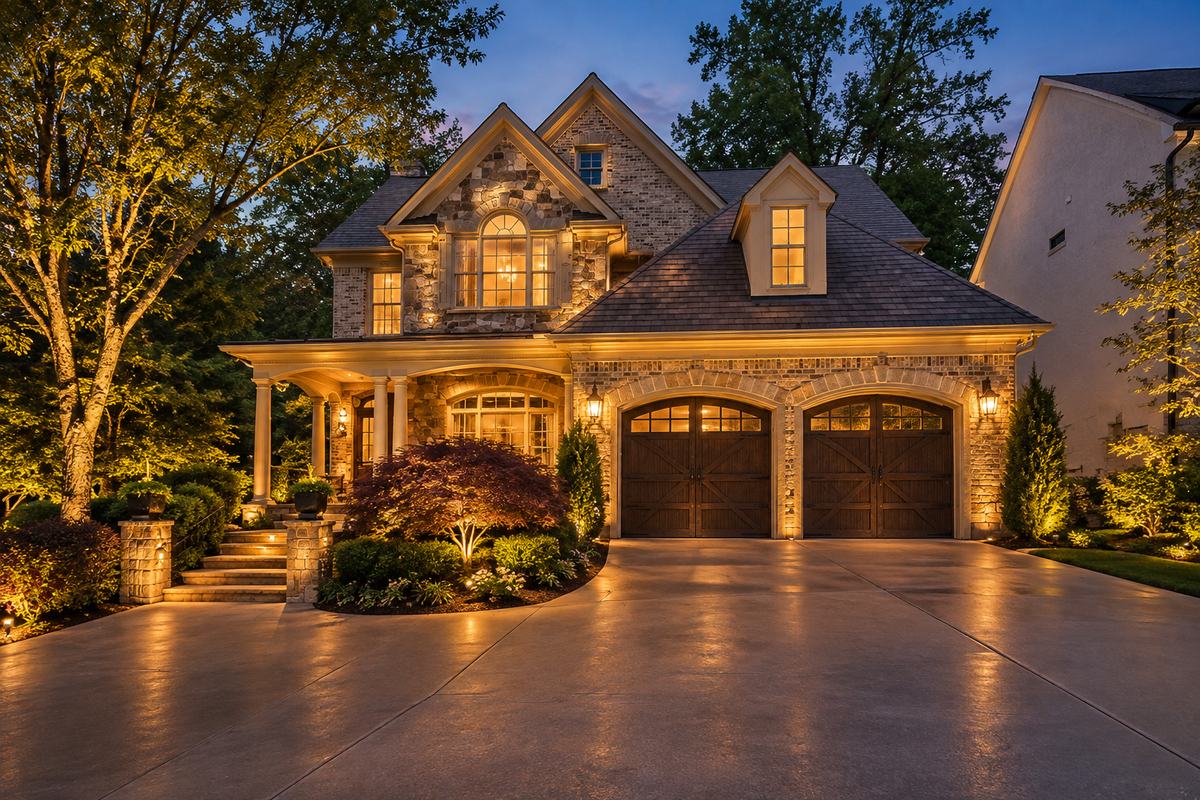
The town splits cleanly in half for lighting purposes.
There are the subdivision lots — quarter to half an acre, a front walk, a bed across the front of the house, a couple of trees that went in with the builder. These are focused jobs. Six to twelve fixtures, one transformer, done in a day. The work is in picking the right two or three subjects and not lighting the other eight.
Then there is the acreage. Plenty of Loganville and the surrounding Walton County countryside is on two, five or ten acres, with a two-hundred-foot drive, mature oaks and pines scattered rather than planted, and a house you cannot actually see from the road. Those are a different job entirely, and the drive is usually the main event.
On a long approach the instinct is to line both sides with fixtures. Do not. A two-hundred-foot drive with twenty-six evenly spaced path lights is an airstrip.
What works is lighting the drive's decisions and its edges indirectly. A fixture at the entry, one at each bend, one where the surface changes from gravel to concrete, one where the drive splits for the garage. In between, the useful light comes from uplit trees along the route — a lit oak canopy forty feet off the drive throws enough ambient light on the ground to read the edge by, and it looks like a property rather than a taxiway.
Long drives also put real distance between the transformer and the far fixtures, which brings voltage drop into play. A run that leaves the transformer at twelve volts can arrive at ten, and the difference between a lamp at twelve volts and the same lamp at ten is visible — dimmer and noticeably more orange. Heavier cable, a multi-tap transformer and splitting the run into zones is how that gets handled, and it is the single most common thing a cheap landscape install gets wrong on a big lot.
Loganville has a lot of pine, and pine is the hardest common tree to light well. The canopy starts high, the trunk is a long bare column, and a wide flood at the base just lights sixty feet of nothing.
The answer on a mature pine is a narrow spot — ten to fifteen degrees — set back from the trunk and aimed to carry all the way up into the crown. It throws a tight column of light up the trunk and catches the underside of the canopy, which is dramatic and uses one fixture rather than three.
Hardwoods are the opposite. An oak or a poplar wants a wider beam closer in, or two fixtures crossing, so the branching structure fills with light instead of a single hot stripe. Mixing the two techniques on one property is normal — we are not going to put the same fixture and the same lamp everywhere and call it a design.
There are still original farmhouses around Loganville, and they take lighting well from the ground. A board-and-batten or clapboard wall grazes beautifully — a fixture set close, light raking almost parallel up the face, so every board edge throws a shadow line. On smooth modern siding that effect looks like a defect; on a hundred-year-old wall it looks like the wall.
Barns, sheds and detached garages are worth including in the plan and usually cost less than people expect, because the runs are short once cable is already in that part of the property.
We do install permanent roofline systems in Loganville, and on the two-storey houses in the newer subdivisions they look excellent.
They are not where we start most properties here. On a wooded Walton County lot, half the roofline is behind a tree from the only angle anyone ever sees the house from, and the money does more in the beds and along the drive. On a subdivision lot with a clean front gable, eave lighting is a fair call — often as a second phase after the ground is done.
A landscape lighting system is not a thing you install and walk away from, and this is where a local crew earns its keep.
Fixtures need re-aiming. Plants grow into beams. A mower clips a brass head and knocks it ten degrees off. A tree that took a narrow spot three years ago now needs a wider beam and more setback. None of that is a fault — it is what a living installation does — and it means somebody has to come back.
If your installer is ninety minutes away, a fifteen-minute aiming adjustment gets scheduled for whenever they are next in the area, which can be never. We are in Loganville. A service call in town is a short drive and it gets done.
Services
Nearby
Questions
No. Heavy tree cover is a problem for roofline lighting, because canopy blocks the sight line to the eaves. For landscape lighting it is the opposite — more to light, and a darker backdrop to light it against.
Yes. The city line runs through two counties and we work both sides, plus Grayson, Snellville, Between, Monroe and Bethlehem.
Fixtures get placed and cable run, usually in a day for a residential system. Then we come back after dark — same evening where we can — and aim everything with you standing where you actually look at the property from. Aiming in daylight is guessing.
You call, and on a system we installed it is a warranty visit rather than a negotiation. Most faults on a low-voltage system are a connector or a lamp, both quick. The failures worth avoiding entirely are the ones caused by cheap fixtures, which is why we do not sell them.
Yes, and on a large Loganville property the drive is often the better half of the budget. It is the first thing anyone sees and the part that actually needs to be navigable after dark.
Landscape lighting goes in year-round — the ground here rarely freezes hard enough to matter. The one scheduling note is that our December is consumed by holiday work, so a landscape install booked in November may land in January.
Call (770) 630-4653 and we will come and walk it at dusk.
Get in touch
Call and talk to someone who does the work, or send the details and we'll get back to you.
Call (770) 630-4653