 Free quote
Landscape Lighting
Solid brass uplighting, path lighting and moonlighting across North Georgia. Low-voltage systems designed at dusk on your property, not off a plan.
Bridges Lighting Pros designs and installs low-voltage landscape lighting across North Georgia — uplighting on trees and stone, path and step lighting, and moonlighting down through mature canopy, all in solid brass. Call (770) 630-4653.
Landscape lighting is the part of exterior lighting that changes how a property feels rather than how it is outlined. Done well you never see a fixture; you see a lit trunk, a glowing stone face, a walk you can follow, and a lot of deliberate darkness in between.
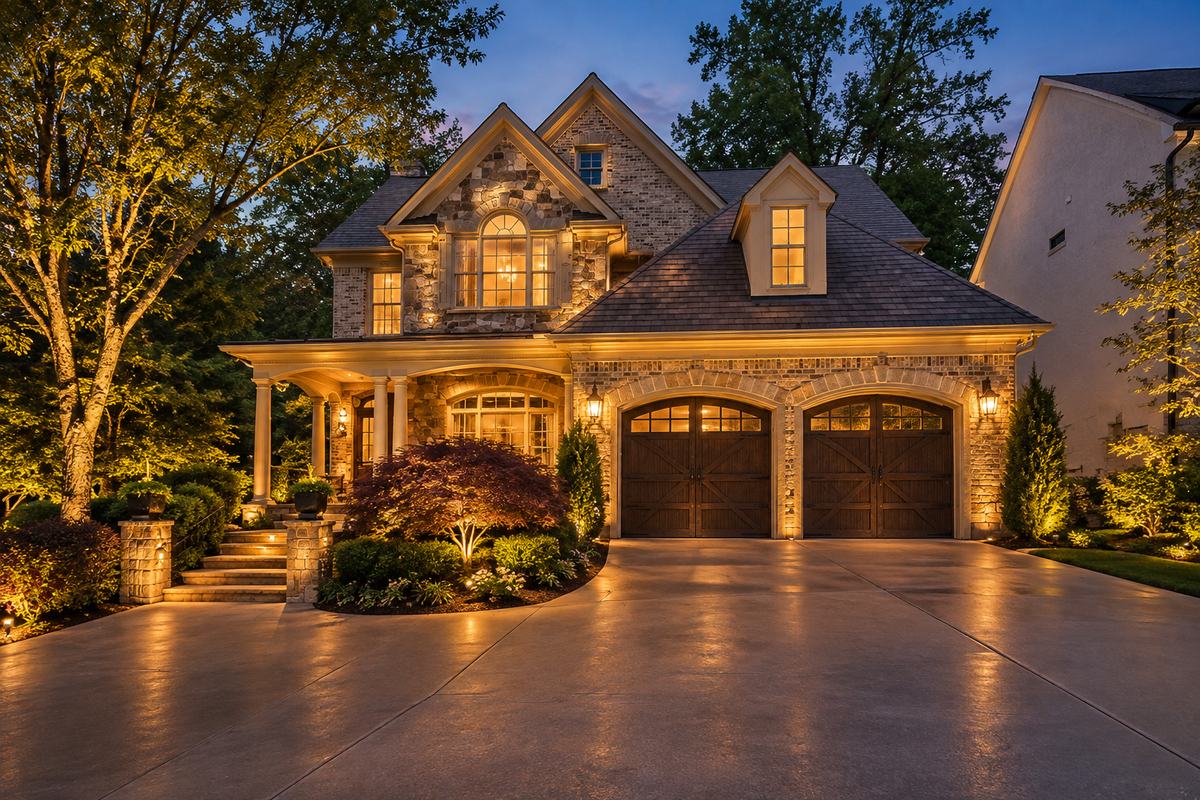
The fixture body is the part you are actually buying. Everything else — the lamp, the lens, the socket — is replaceable.
Solid cast brass does not corrode. It oxidises to a patina, going from bright gold to a soft brown over two or three seasons, and then stops changing. That patina is protective rather than decorative, and it is why a brass fixture installed in 2010 is still a working fixture.
Aluminium is the usual cheaper option. In a bed under irrigation it pits, the powder coat blisters and lifts, and water eventually gets past the lens gasket into the socket. Composite fixtures go chalky in Georgia sun and get brittle enough to crack underfoot.
Wall thickness matters as much as the metal. Thin stamped brass dents; cast brass takes a mower clip and bends.
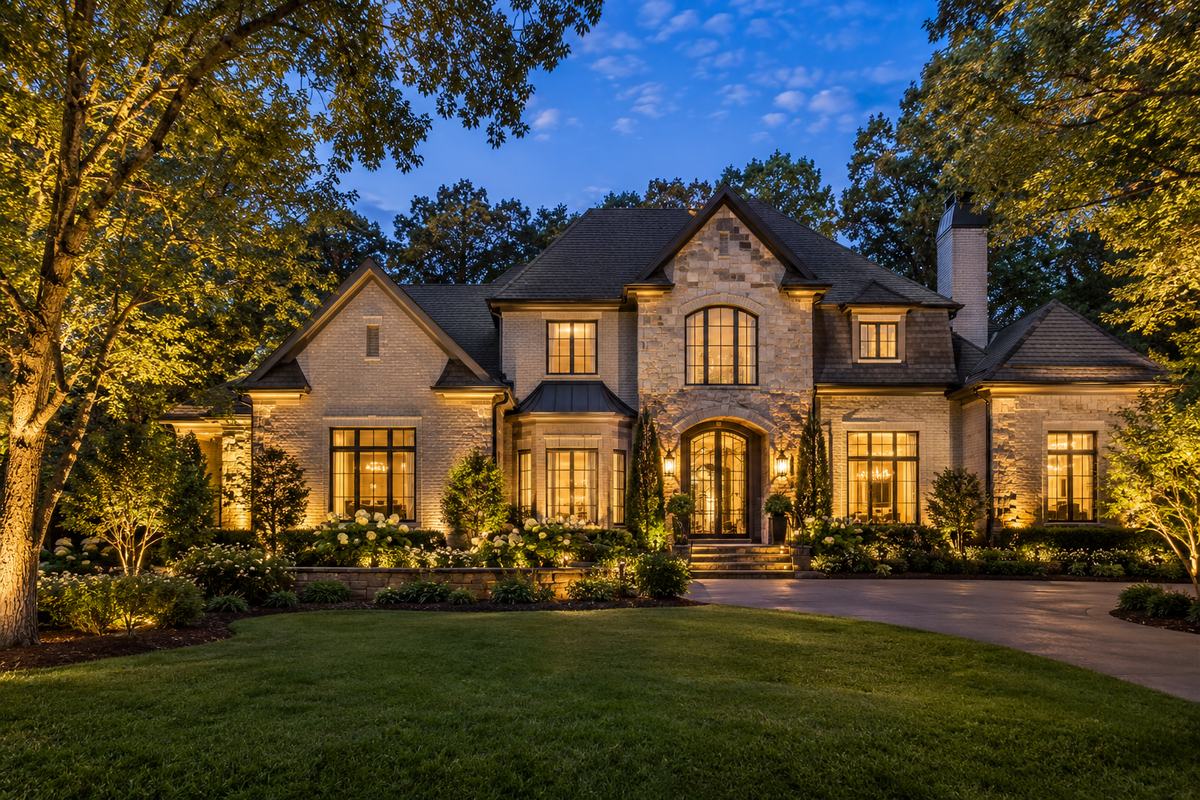
The fixture is the same. What changes is where it sits and how wide the beam is.
Grazing. Fixture tight to the surface, maybe a foot out, light raking almost parallel up the face. Every irregularity throws a shadow. It is the right answer for a stone chimney, brick, or a rough-sawn timber post, and the wrong answer for smooth stucco, where it shows every trowel mark.
Washing. Fixture pulled back several feet with a wide flood, light landing evenly. Flatters smooth surfaces and modern facades.
Moonlighting. A shielded fixture mounted high in a tree, aimed down. Light filters through the branches and drops their pattern onto the lawn below. It is the most natural-looking effect in landscape lighting and the one people rarely request, because when it is done right there is no visible source — it reads as moonlight.
Silhouetting. Light the wall behind a specimen plant rather than the plant. A Japanese maple or a sculptural shrub becomes a black shape against a lit surface. Very effective on one or two plants and overwhelming on ten.
A narrow spot, roughly ten to fifteen degrees, throws a tight column — that is what puts light sixty feet up a pine without spilling everywhere.
A wide flood, sixty degrees and up, covers a broad low shrub or a section of wall.
Using a flood where a spot belongs is why some uplighting looks like a car park: the light never reaches the canopy, it just washes the trunk and the ground around it. Matching beam angle to the height and width of the target is most of what separates a designed system from a box of fixtures.
Colour temperature belongs in the same conversation. Landscape lighting lives at 2700K, occasionally 3000K. Anything cooler turns foliage grey-blue and makes a warm brick house look like a filling station.
Almost every badly lit front walk has the same fault: matched fixtures at even spacing down both sides, each one a glare source at knee height.
A path light should light the path. That means a shielded top so you see a pool of light rather than the lamp, spacing that is staggered rather than paired, and noticeably fewer fixtures than people assume. Two or three down a front walk is usually right; eight is a runway.
Steps, grade changes and the edge of a driveway are the genuine safety items, and those get treated separately — often lit from the side, or from beneath a tread, so the tripping hazard is lit without a fixture standing in the way.
Low-voltage systems run at 12 volts from a transformer, and volts are lost along the cable. Push too many fixtures onto one long run, or use cable that is too thin, and the fixtures at the far end sit dimmer and warmer than the ones near the transformer.
Homeowners read that as failing lamps. It is a design fault, and no replacement lamp fixes it.
The answers get decided before anything is buried: heavier gauge cable on long legs, splitting the load across multiple runs, using the transformer's higher voltage taps to compensate, and hub wiring so no single leg carries too much. This is the least visible part of the job and the part that decides whether the system still looks right in year five.
Call or text (770) 630-4653. Quoted per property after a visit — fixture count, cable runs, transformer size and how workable the ground is decide the number, not square footage.
Included
Typical range: Quoted per property
Coverage
Questions
Yes — re-aiming as planting grows in is part of the service after installation, along with repairs and additions later. A landscape lighting design is aimed at a garden on the day it is installed, and the garden does not hold still.
A shrub that was eighteen inches becomes three feet and swallows the fixture lighting it. A young tree's canopy rises out of the beam. Beds get topped up with pine straw or mulch every spring and fixtures sink into it.
None of that is a fault, and all of it is why these systems want an occasional adjustment — raising fixtures on stems, re-aiming, sometimes moving one four feet. It is a short visit, not a rebuild, and it is worth asking any installer whether they come back to do it.
Most residential landscape installations run one to two days once the design is agreed. Larger properties, long cable runs or a lot of hardscape take longer, and you know the schedule before the crew arrives.
The design visit comes first and is separate: we walk the property near dusk, then you get the layout and a written price. Nothing is dug until you approve it.
Usually. A lot of our work is systems somebody else installed that have gone patchy — a dark run, a transformer past its life, fixtures buried in mulch, or a leg cut through when a bed was replanted.
Those are ordinary repairs. What is worth knowing before spending money is whether the existing fixtures are brass or aluminium, because repairing a corroded aluminium system is money into something that will keep failing, and at that point replacing fixtures while reusing the cable and transformer is often the better value.
Yes. Retaining walls, seat walls, outdoor kitchens and steps all take low-profile fixtures that light the surface without putting a glare source at seating height. Pergolas and covered patios take downlighting rather than uplighting.
Water features are their own specification — fixtures rated for submersion, with the transformer and connections kept well clear — and they are worth doing properly rather than adapting a standard uplight.
On the property, near dusk, walking it with you. That is not a sales convention; it is that you cannot tell what is worth lighting from a plan or a daytime photo. Which trees have structure worth showing. Where the house is already lit by windows. Where darkness is doing useful work.
You get a fixture count, a layout and a written price before anything is dug.
Get in touch
Call and talk to someone who does the work, or send the details and we'll get back to you.
Call (770) 630-4653